



If there’s one team in an organization that’s chronically under-resourced, it’s procurement. Team members are consistently asked to do more with less—forcing procurement teams to prioritize end-to-end margin management more than anything else, according to McKinsey.
Combine that with a constant battle to get internal stakeholders to bring you into the process at the right time, and there’s a lot of last-minute long hours and tedious box-checking built into every level of procurement, but especially for the most junior employees.
That’s no longer quite true.
Adding AI into your procurement workflow can have tremendous benefits—across procurement teams Ironclad surveyed in its 2026 State of AI in Procurement report, 97.5% reported that AI improved how they worked. Artificial intelligence completely changes how procurement professionals can get things done.
Yes, artificial intelligence can speed up your work and automate manual tasks. But that’s not what makes it exciting for procurement. What it really does is give you a chance to pursue more meaningful, strategic, exciting commercial work…instead of staying mired in endless “did they sign this?” back-and-forths.
Ironclad sat down with Tom Mills, author of “Procure Bites,” to discuss how AI can be useful for procurement if used wisely. Here’s what to keep in mind.
In your early career, a practical approach you can take is to learn as much as possible—and leaning too much on AI too soon may cut your career off at the knees.
“I’m a really big advocate for finding a mentor, and learning from the people around you,” says Mills. “That doesn’t necessarily mean someone who works in procurement. Some of my best mentors have been far removed from my organization, and it’s such a valuable perspective.”
AI can certainly answer questions about specific aspects of procurement if you’re not sure, but outsourcing this relationship-building to AI won’t help you get ahead. Mills cautions junior professionals to avoid outsourcing too much to AI too soon.
According to Mills, “AI may be quicker, but it can hold back your ability to learn and challenge yourself, and that’s a key part of any junior role. Procurement is a constant exercise in learning new things, whether that’s being assigned to a new area of the business or taking on new technology.”
Instead, keep your head up during meetings and really listen to how conversations flow. Attend as many meetings in person, if you can. If there’s someone you admire, or you think is doing interesting work, try to get to know them.
“When you’re new to an organization, you have to be a bit brave, and put yourself out there,” says Mills. “You can ask your manager, or you may have a formal mentoring program, but there’s always more informal learning opportunities, too. So much of how I learned to negotiate came from listening in to my boss running a meeting on speakerphone, and taking notes.”
Of course, that doesn’t mean you have to slog through mundane, tedious work when AI can handle that. Procurement professionals as a whole aren’t all bought into using AI yet, but it’s increasingly included on job descriptions and expected for junior professionals to know when and how to use it well. When Ironclad asked procurement professionals about their AI adoption, it found that usage spans 14 different use cases, with no clear winner rising to the top.
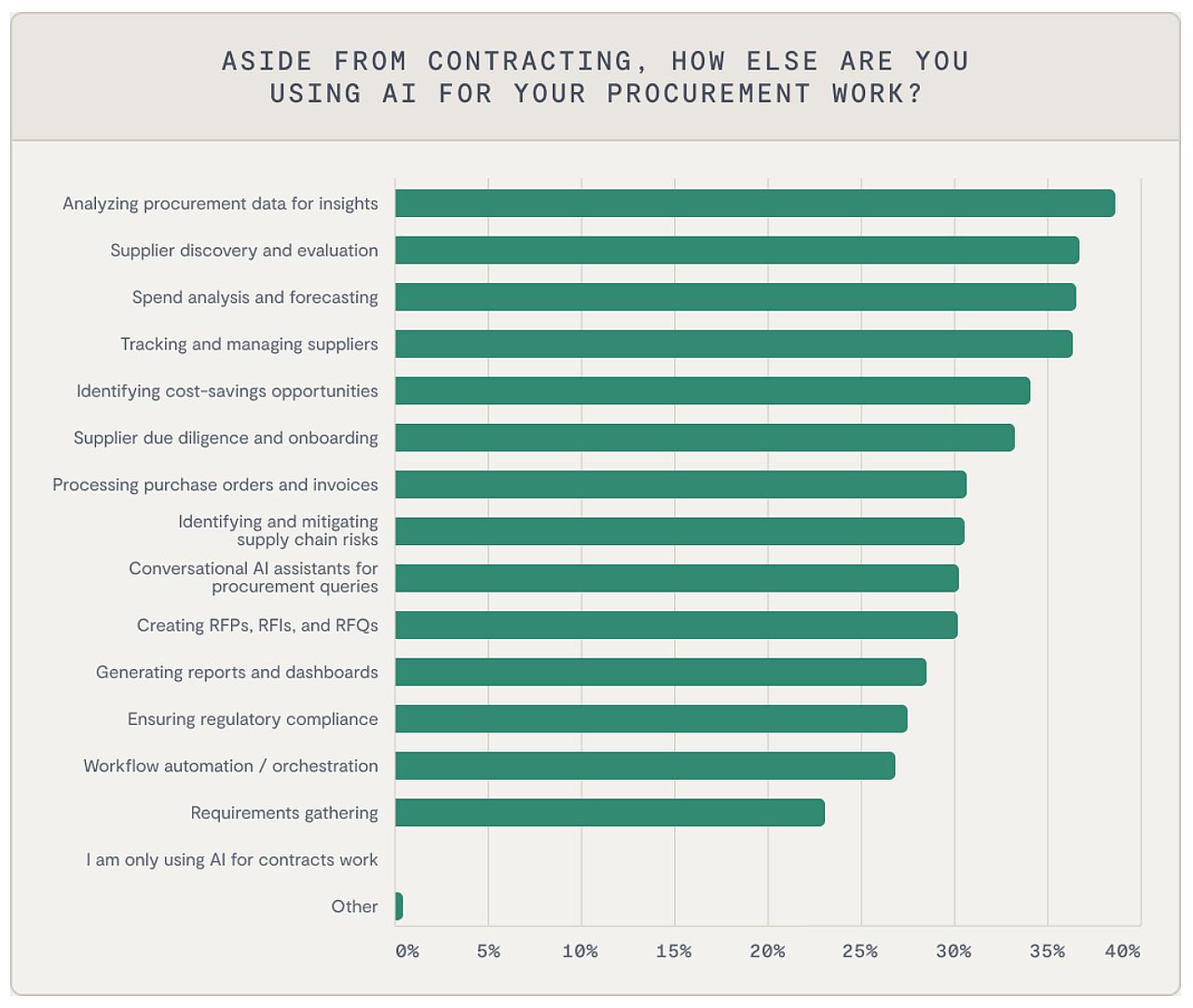
The best use cases, says Mills, are simple, repetitive tasks that procurement professionals honestly don’t like doing anyway, like:
“If you find yourself doing a repeatable, mind-numbing task that is taking up a lot of time, that’s a great spot to use AI,” advises Mills. “My gut check is always, ‘Are you using your brain?’ And if the answer is no, go for it.”
AI can also help you get answers to questions you wouldn’t normally be able to find yourself. AI’s ability to take massive amounts of data and turn it into insights makes it an ideal collaborator as you work on more strategic decisions. If you’ve ever asked, “What’s the average time to complete a purchase order?” or wondered, “Which vendors have the longest-standing relationships?” AI can help.
As AI becomes more and more prevalent in the workplace, Mills recommends focusing on building your soft skills just as much as studying spend management or nailing the right request for proposal format.
“I think soft skills are going to really differentiate the workforce moving forward,” he says. “Can you read the room? Can you negotiate effectively in tough circumstances? Can you persuade and influence? If you try to replace those with AI, it becomes very flat and transactional. You will lose the trust of your colleagues.”
Mills recommends building these skills most of all:
It’s communication where Mills sees junior professionals make mistakes with AI.
“You can absolutely guarantee that the best way to ruin a relationship with someone is to send them AI-generated emails. Yes, they can tell. It might be faster, but the email won’t have context. It won’t have empathy. It won’t have any kind of personality. You’re missing the point of why you’re communicating in the first place,” explains Mills.
Mills says, “AI can be incredibly useful, but it’s still up to you to make the right decisions. Your human judgment needs to come into play. We should be asking the right questions to protect our organizations.”
This includes questions like:
Beyond the technical aspects of procurement, what makes someone great at procurement has everything to do with how they build relationships—and that’s something AI can’t replace.
“Your biggest impact in an organization isn’t your technical skills or how experienced you are. It’s how you are able to influence the organization to do the right thing. It’s your relationships. It’s your stakeholder management. It’s your collaboration,” says Mills. “If you get rid of all of those things that build trust with other people, you’re limiting your ability to have an impact.”
This story was produced by Ironclad and reviewed and distributed by Stacker.


