

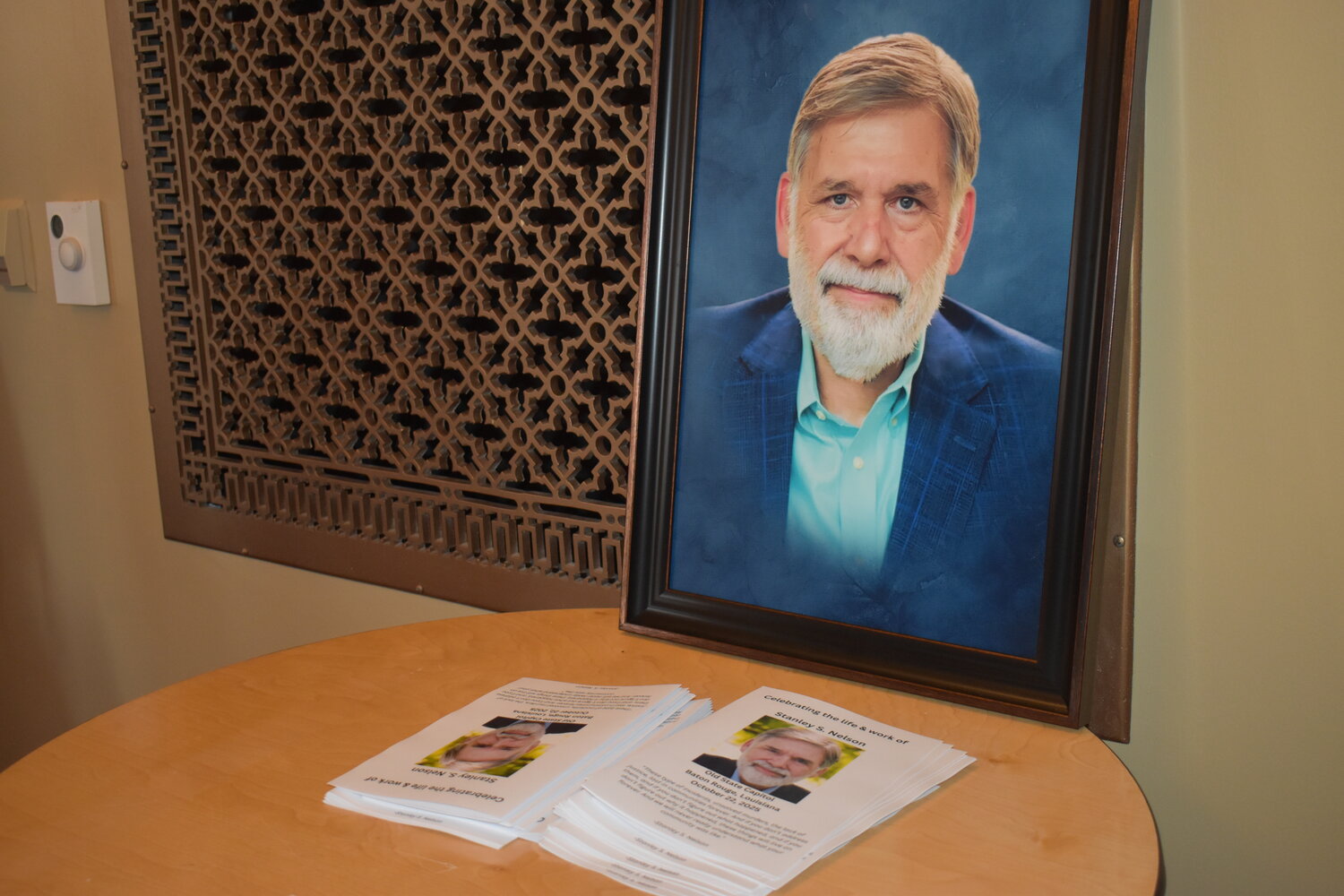


BATON ROUGE — The LSU Manship School of Mass Communication honored the life and work of Stanley Nelson Wednesday at the Old State Capitol, celebrating a small-town editor whose investigations into civil rights era murders brought truth and peace to stories once buried.
Nelson, who died in early June at the age of 69, spent decades uncovering racial violence in Louisiana and Mississippi.
As editor of the Concordia Sentinel in Ferriday, Louisiana, Nelson published more than 150 stories on Klan-era killings, giving victims’ families long-denied answers and earning a 2011 Pulitzer Prize finalist nod for local reporting.
“Most of us have a moment in life when something happens, and we can either step up or ignore the call,” said Christopher Drew, a Manship professor and the director of LSU’s Cold Case Project. “That was his moment. We’re all gathered here because of the inspiring way that he responded.”
Drew, who worked alongside Nelson and former LSU professor Jay Shelledy, said the LSU Cold Case Project began as a way to assist Nelson’s reporting. LSU’s project focuses on unsolved civil rights murders.
Nelson brought readers into the world of Frank Morris, the Black cobbler whose shoe shop once hummed with the sound of whirring machines and city chatter before it was destroyed by the Ku Klux Klan in 1964.
“Stanley didn’t stop after that first story about Frank Morris, whose shoe shop was firebombed,” Drew said. “He wrote 150 stories over the next four years about Klan murders. His work enabled families to learn who had killed their loved ones and why.”
Hank Klibanoff, a Pulitzer Prize-winning author and the director of Emory University’s Civil Rights Cold Cases Project, described Nelson as “the most inconspicuous person in the group, and the most auspicious.”
“Single-handedly, week after week, Stanley uncovered more leads, more witnesses, more documents and more information than the FBI,” he said. “He did it quietly, steadily, without pretense or ambush.”
Klibanoff said Nelson’s methods were rooted in humanity and personal connection.
“Stanley approached people slowly, face-to-face, hands out and notebook closed,” he said. “He was without guile. His goal was to avoid a one-and-done interview.”
That approach, Klibanoff said, allowed Nelson to reveal the depth of his subjects’ lives, victims and perpetrators alike.
“As a writer, Stanley used all these details to draw his readers into that world,” Klibanoff said. “He was a master of the art of source development. A slow-cooked process that relied on being there day after day.”
Tori Stillwell, who interned with Nelson and now works as a lawyer in Washington, D.C., recalled her first meeting with him after hearing lecture at the University of North Carolina. She soon joined his investigation into Morris’ case, where Nelson insisted she accompany him to confront a former Klan member suspected of the murder.
“I was a Black 19-year-old young woman, and we were going to approach someone who was not only a member of the Klan but an alleged murderer,” Stillwell said. “Stanley handled my emotions with care and sincerity. He approached his work with the same kindness he showed me.”
Stillwell said Nelson often put himself in dangerous situations while in pursuit of interviews and documents connected to the long-unsolved killings. His persistence, she said, stemmed from a sense of responsibility to the families affected by the violence.
“He was fearless,” she said. “He picked up the ball where others dropped it.”
Nelson stayed in touch with Stillwell for years after her internship, attending her graduations, officiating her wedding and celebrating her first pregnancy.
Two days before his death, Nelson sent her a photo of the home he shared with his companion, Nancy, writing, “This is now my home. The old school doors creak and wail when they open.” A simple note that, Stillwell said, captured Nelson’s warmth and the descriptive way he saw the world.
“Stanley knew I was nervous about motherhood,” Stillwell said. “His last words to me were ones of reassurance and optimism. ‘Think less about the fear and more about enjoying it.’”
The memorial drew journalists, students and family members of civil rights victims whom Nelson helped bring justice to. Through their stories, they portrayed a man who pursued truth not with confrontation, but with compassion.
“Stanley showed us what journalism can be at its best,” Drew said. “Patient, fearless and deeply human. He reminded us that the stories worth telling are often the hardest to uncover, but also the ones that matter most. He didn’t just write stories. He gave families the dignity of knowing the truth.”


