


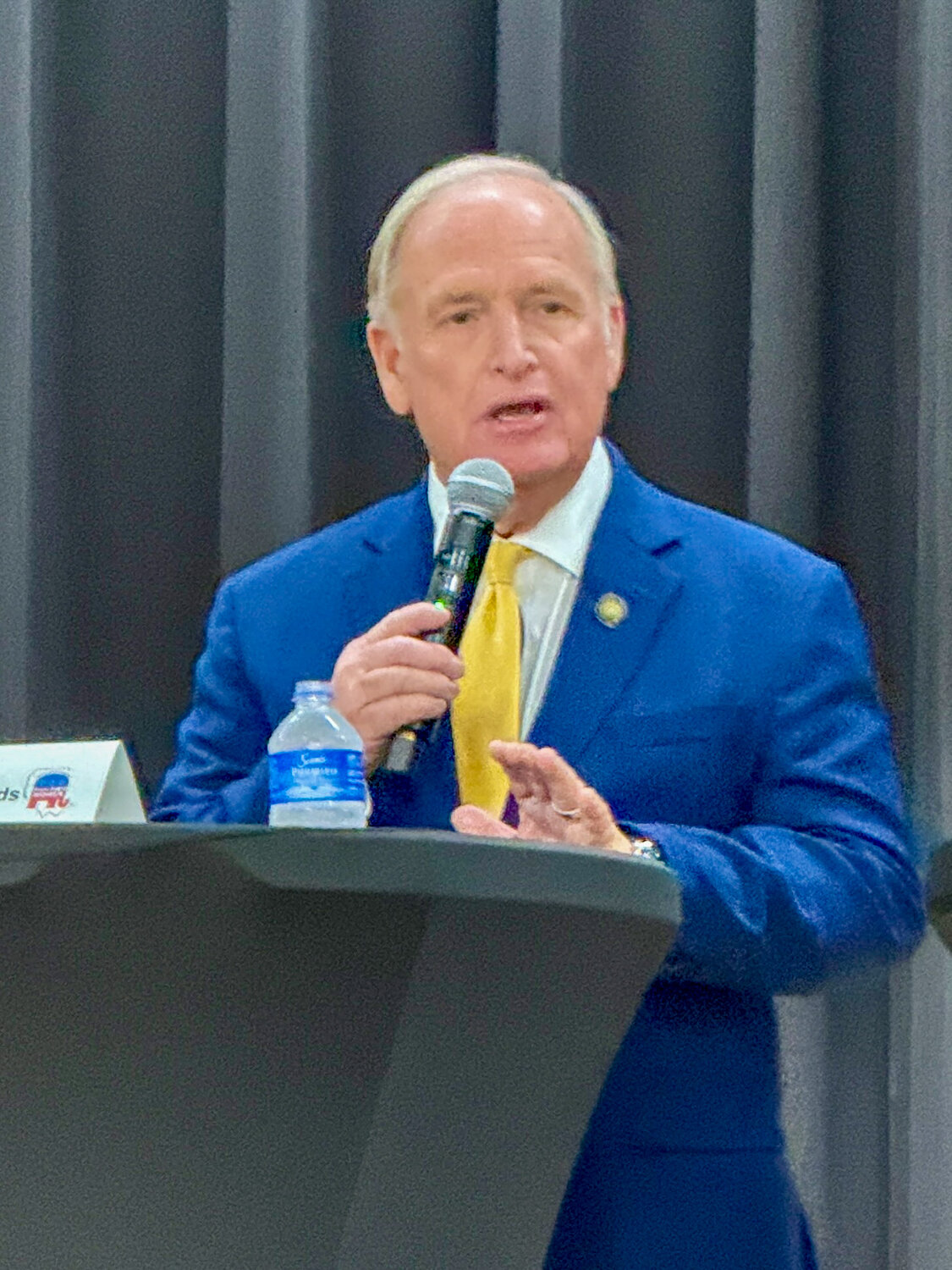


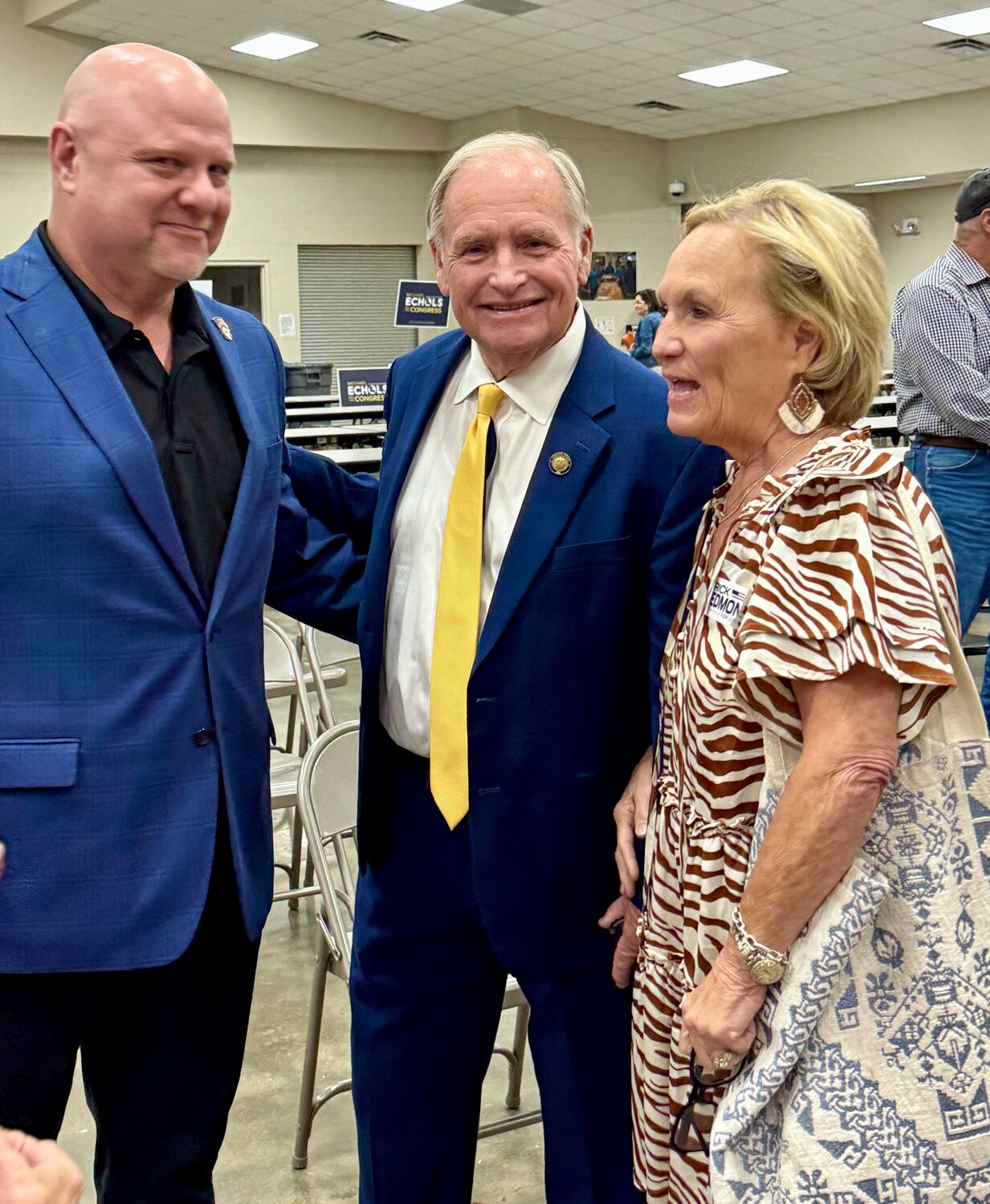


WATSON, La. — All seven Republican candidates running for Louisiana's 5th Congressional District seat shared the stage Thursday night at Live Oak High School, making their case to voters three weeks before the May 16 closed Republican primary.
The debate, co-hosted by the Liberty Belles Republican Women's Club and Livingston Parish Republican Women, drew a large crowd, making it one of the first times the full GOP field appeared together in a single forum. Candidates Misti Cordell, Rep. Mike Echols, Sen. Rick Edmonds, Austin Magee, Michael Mebruer, Sen. Blake Miguez, and Sammy Wyatt answered questions on immigration and labor, education, flood mitigation, rural healthcare, water infrastructure, carbon capture, federal earmarks, Social Security, and taxes.
Talk 107.3 host Brian Haldane moderated. Panelists, who questioned the candidates, included French Settlement Mayor Jeremy Aydell, Louisiana Press Association Executive Director McHugh David, and WBRZ Channel 2 reporter Abigail Whitam. Liberty Belles RWC President Bridgette Gilbert gave opening remarks, Livingston Parish Republican Women President Patra Easley led the Pledge of Allegiance, and LPRW member Pennie Thoms delivered the invocation.
The field
Seven Republicans are running to succeed U.S. Rep. Julia Letlow, who is challenging U.S. Sen. Bill Cassidy in the May 16 Senate primary. The 5th District spans northeastern Louisiana, through the Florida Parishes, into parts of East Baton Rouge and Livingston parishes. It is rated R+18 by the Cook Political Report, meaning the winner of the Republican primary is heavily favored in November.
Sen. Rick Edmonds, R-Baton Rouge, has served in the Louisiana Legislature since 2016 and represents Senate District 6, which covers parts of East Baton Rouge, Livingston, and St. Helena parishes. He chairs the Senate Education Committee and is the only candidate in the Republican field who lives in Baton Rouge, the district's largest population center.
Sen. Blake Miguez, R-New Iberia, represents state Senate District 22 and previously served as Louisiana House Republican Majority Leader. A corporate attorney and oil and gas executive, Miguez has been endorsed by President Donald Trump and the Club for Growth and leads the field in fundraising, with $3.6 million on hand at the end of 2025. His home in New Iberia is outside the district.
Rep. Mike Echols, R-Monroe, represents state House District 14 and has served in the Louisiana House since 2019. A real estate developer, Echols, entered the race in February and has said he is prepared to spend up to $1 million of his own money on the campaign.
Misti Cordell of West Monroe chairs the Louisiana Board of Regents, appointed by Gov. Jeff Landry. She is the only woman in the Republican field and one of three candidates who have never held elected office.
Austin Magee of Franklinton owns an industrial construction firm in Washington Parish. He has not previously sought public office.
Michael Mebruer of St. Francisville is a traveling medical professional from West Feliciana Parish. He has not previously sought public office.
Sammy Wyatt of Denham Springs is chief compliance officer at LSU Health Shreveport and a former Bossier City police officer of more than 20 years. He holds an MBA from Centenary College of Louisiana and a Ph.D. from LSU. Wyatt is the only candidate in the Republican field who lives in Livingston Parish.
Immigration and agricultural labor
Panelist Abigail Whitham opened the questioning with a two-part question on H-2A and H-2B temporary agricultural worker visas and the H-1B skilled worker program.
Wyatt said, "We have plenty of qualified people here" to do the work, and that Americans will take agricultural jobs if given the opportunity. Miguez drew the sharpest contrast, saying he opposes amnesty but that temporary workers are necessary to "give our farmers the resources they need to feed our nation." On H-1B, Miguez said "one out of 10 births are anchor babies" and called the situation an invasion "without firing a single shot."
Edmonds pointed to legislation he is currently carrying in the state Senate on career realignment and brain drain, saying, "I'm not waiting to do something about it. I'm doing it now." Echols said he is working with industry on reform. Cordell focused on short-term credentialing and said federal legislation needs to address the actual needs of Louisiana's sugarcane and agricultural producers.
Education
On Louisiana's LA GATOR school voucher program and the future of the U.S. Department of Education, the field was uniformly supportive of GATOR and uniformly in favor of eliminating the federal Department of Education.
Echols said he supports both GATOR and public schools and that GATOR should target students in failing schools. Edmonds, who chairs the Senate Education Committee and carried the GATOR legislation, said the program is structured to avoid harming public schools. Magee said, "The closer (funding and decision making) is to the local level, the better results you have." Mebruer tied his opposition to the Department of Education to federal student loans, saying the department guarantees loans for colleges that produce "blue-haired liberals."
Miguez said, "parents make the best decisions" for their children. Wyatt backed GATOR but called for accountability, saying his approach is "trust but verify." Cordell tied her opposition to federal education involvement to DEI programs in higher education, which she said persist because of federal grant conditions.
Flood insurance and mitigation
Aydell pressed candidates on high flood insurance premiums, FEMA grants, and price stability.
Miguez pointed to the Comite River Diversion Canal and other local flood-mitigation projects, saying that completed infrastructure improves flood ratings and lowers premiums. Mebruer and Magee argued for free-market solutions. Edmonds credited former Congressman Garret Graves, saying, "Garret Graves did a phenomenal job, and we have to continue to fight for the dollars to keep this work going."
Echols called for a modern risk-rating system "with fair risk rating all across the market" and accountability from the Army Corps of Engineers. Cordell said it is "important to work with local engineers to understand the risk." Wyatt said the issue comes down to removing "self-serving politicians" from the process.
Rural healthcare
Candidates were asked about rural healthcare deserts, with the moderator noting that 25 percent of rural hospitals are under threat of closure.
Miguez said the 5th Congressional District has more rural hospitals than any other district in the state, and that the problems began with the Affordable Care Act. He called for "access to life-saving healthcare" and innovative solutions to keep rural hospitals open. Echols said, "Quality healthcare is not more expensive. Quality healthcare reduces costs." Cordell raised insurance reform and flagged private equity's role in North Louisiana healthcare as a specific concern.
Edmonds and other candidates raised Medicaid reimbursement rates, with Mebruer saying rates are "too low" for rural providers to stay open. Wyatt called for block grants. Several candidates returned to repealing the Affordable Care Act in the small-business healthcare segment that followed.
Water systems
On Louisiana's Grade D water system rating, candidates split on whether water infrastructure is a federal responsibility at all.
Mebruer said federal money should not be used to address water system failures. Magee called it a state issue but said he would fight for federal funding if needed. Edmonds said existing organizations are working on the problem. Echols proposed long-term, low-interest loans and consolidation of smaller water systems. Cordell called it a state issue. Wyatt asked, "Where is our tax money going?" and Miguez framed the issue as one of fiscal responsibility, suggesting that state surplus funds could be directed to water grants.
Small business healthcare costs
Aydell asked how candidates would work in Congress to reduce healthcare costs for small business owners and employees.
Magee called for clarified billing and healthcare cost transparency. Mebruer proposed reducing the corporate tax rate. Miguez, a small business owner, said patients and doctors need to be returned to the center of the relationship, "and not the bureaucrats." Wyatt said Republicans have failed to eliminate the Affordable Care Act and that doing so is essential. Cordell called for insurance reform and addressed malpractice insurance costs, saying, "We need to get back to paying for quality healthcare," and "Let doctors get back to providing healthcare." Echols called for "transparency in pricing" and said consumers should be allowed to use their premium dollars as they see fit. Edmonds said, "Obamacare must be repealed."
Carbon capture
Panelist Abigail Whitam asked the most locally charged question of the night: given concerns about environmental impact and property values, should the parish ask current carbon capture operations to stop? She drew a distinction between enhanced oil recovery operations, like the long-running Lockhart facility in Denham Springs, and newer carbon sequestration projects.
Cordell said the topic made her uncomfortable. Echols said the parish should have a choice and opposed private companies using private land, adding that 45Q tax credits are "not the way to incentivize oil and gas." Edmonds blamed the Obama and Biden administrations but said the Trump administration is expanding the credits by $600 million and that the solution is "not an easy one." Magee called for repealing 45Q outright. Mebruer said the decision should be left to state and local governments.
Miguez said, "I don't agree with any Green New Deal scams," and said his focus is on private property rights. Wyatt drew a direct line to state leadership, saying, "Jeff Landry is pushing this." Cordell, who has worked for the Landry administration, responded, "Just because I have worked for Jeff Landry doesn't mean I agree with everything he does."
Infrastructure and residency
Louisiana Press Association Executive Director McHugh David asked about federal infrastructure priorities, which produced one of the night's sharper exchanges when Wyatt again drew a contrast with Miguez over district residency, tying it to accountability for local officials.
Miguez responded by pointing to his first-year state Senate record, saying he brought $100 million in funding back to his district. Magee focused on redirecting carbon capture dollars to traditional infrastructure. Edmonds said he would "get in the boat with the parish presidents and actually go look with them" at flood and drainage sites and bring federal dollars back to the region. Echols named specific priorities: finishing the Comite River Diversion Canal and addressing the Amite and Pearl rivers. Cordell said she would "work with our state and local leaders to bring home funds."
Lightning round
On federal earmarks, Cordell said the key is working well with local officials and leaving no money on the table. Echols said a targeted approach is a necessity, especially given prior federal missteps. Edmonds focused on ensuring dollars are spent correctly and rooting out fraud, waste, and abuse. Magee said earmarks should be judged on a case-by-case basis. Mebruer opposed earmarks outright. Miguez urged extreme caution tied to debt reduction. Wyatt said earmarks are inevitable, but "get rid of the pork."
On Social Security solvency, Wyatt and Miguez both framed the issue around fraud, waste, and abuse, with Miguez adding that illegal immigrants "can't apply for government benefits that Americans have to pay for." Mebruer said the retirement age should be raised. Magee called Social Security "a piggy bank for politicians." Edmonds emphasized fiscal discipline and a balanced budget. Echols said commitments to current beneficiaries must be kept and that he would look at more market-driven approaches for future ones.
On a federal gas tax increase to widen Interstate 12, the field was uniformly opposed. Wyatt said wasteful spending should be cut first. Miguez said Congress needs to "learn to live within its means." Mebruer called for eliminating all excise taxes as part of broader simplification. Magee said no new taxes and called for electing "common sense blue collar people." Edmonds noted he voted against every tax proposed by former Gov. John Bel Edwards. Echols spoke about tariffs and trade policy, as well as global competitiveness in oil and gas. Cordell also opposed new taxes.
Closing statements
Cordell leaned into her outsider status: "I am not a politician. This is my first time running for office. I did this because I am from a rural area and I care."
Echols said, "On day one, I will show up ready to get to work," and pledged to make the U.S. the most "energy dominant country in the world."
Edmonds emphasized his work ethic and local roots: "No one outworks me. In 11 years, I have not missed a day (at the state legislature)." He added that voters need "someone who lives in this district," a pointed line given Miguez's out-of-district official residence.
Magee said, "These politicians are selling the future of our children faster than we can do anything about it."
Mebruer emphasized the specificity of plans and said he has not taken donor money.
Miguez closed on his Trump endorsement: "President Trump trusts me to get this job done."
Wyatt closed directly: "I want this job. I want to represent you."
What's next
The closed Republican primary is May 16. Under Louisiana's new closed primary system, only registered Republicans or unaffiliated voters can vote in the Republican primary. If no candidate receives more than 50 percent of the vote, the top two finishers advance to a runoff on June 27. The general election is November 3.
Early voting runs May 2 through May 9, excluding Sunday, May 3, from 8:30 a.m. to 6 p.m. at the Denham Springs Walker-Branch Library and Registrar of Voters office.


