The Amite River Drainage & Water Conservation District meeting held on February 10, 2026, struck an especially hopeful tone, as several discussions and updates on the status of the Amite River Basin Commission (ARBC) Master Plan were presented to the board for review.
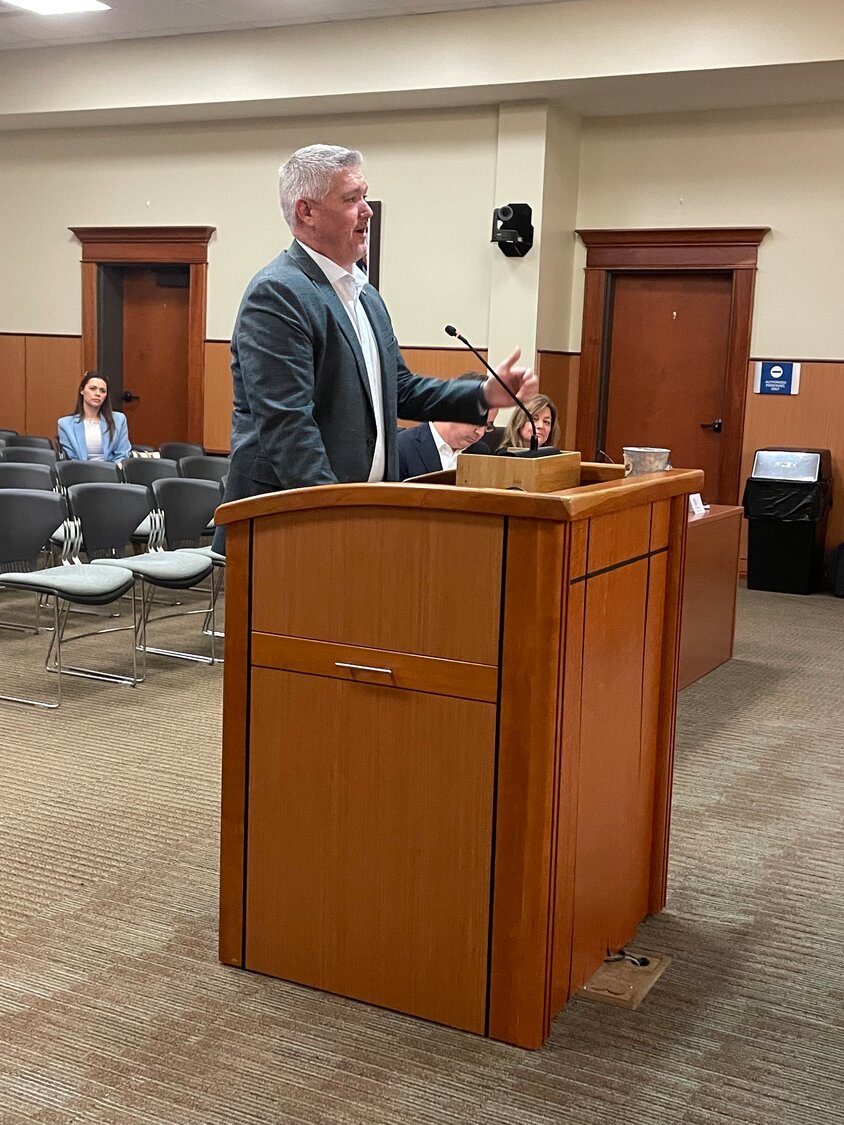
Before the meeting began in earnest, State Representative Roger Wilder of District 17, who was in attendance, received special recognition from President Clark. "I'm taking notes on how we can stay level," Wilder stated. "I'm just here to learn and do what I have to do to be a part of the process in progress."
Paul Sawyer, the ARBC Chief Advisor, was the first to approach the stand to discuss the Upper Amite Restoration Project. "We have completed our due diligence" on the project, Sawyer explained, and "it's under review right now at the state office of facility planning and control."
The state office will review the project and, if it meets their requirements, proceed to closing. A past article on the developments leading up to this progress report discussed that this project will "help protect homes and communities in the seven-parish basin and enable the ARBC to restore sections of the river that will reduce flood risk, and one day, we believe, provide recreational opportunities for citizens in the region."
The USDA Natural Resources Conservation Service will administer $2 million in funding for the project, which was secured by Congresswoman Julia Letlow. Overall, that leaves "two million in cash in capital outlay, two million in a cash line of credit," and another two million in the "governor's capital outlay budget" thanks to confirmation between ARBC and "legislative appropriations committees as well as the division of administration."
"We're positioning ourselves to take advantage of as many resources as we have available in case this [project] takes off, which we expect it to do."
The Upper Amite Restoration Project "could include parts of our St. Helena property," Sawyer explained, but "the focus for [this project] will be Livingston Parish." All work to be done in Livingston Parish will be discussed beforehand with the Commissioner and Parish President Randy Delatte.
The Comite River Diversion Canal project follows a similar pattern. Despite a 3-4-year delay caused by utility relocation of the interstate gas pipeline, final steps are underway to complete the main diversion structure included in the project. With the minimal amount of extra construction happening at the area, no extra time is added to the project's completion date, and the clearing and snagging of the three bodies of water that flow from Zachary into Baker are already underway.
"The progress is moving, advancing… the strict Corps of Engineers timeline is that their estimate is approximately mid to late 2028 to complete the project," Sawyer added. "I think experience would tell us that the first or second quarter of 2029 is more realistic."
Another project from the U.S. Army Corps of Engineers (USACE) is the 5 Bayous project. The $225 million project for "environmental and historic preservation" is still underway in the two bayous in the central area with only half of the three channels in the bayous of the southern area having been completed so far. The delay on those areas comes from a need for mitigation which results in the project's proposed completion date remaining a mystery until further action is taken.
In the effort to achieve further clarification and progress of these projects, ARBC has conducted outreach to local areas being affected by these projects, met with staff of Congresswoman Letlow, presented progress reports to Senator Valerie Hodges, held meetings with stakeholders, and also held several meetings and speeches discussing the scope of the projects. Outreach attempts will continue throughout February and early March "with various groups who have asked us to speak so that we can talk about not just master planning efforts but also our collective efforts on project development and delivery."
"We're commemorating the 10th anniversary of the March 2016 flood, which flooded this parish and other parishes in the Amite River basin, as well as the historic [August] 2016 flood, which flooded much of Louisiana, but especially the Amite River basin."
Commissioner Clint Cointment noted that efforts to work on the small details may also be prudent. "I think we need to look at some smaller projects," Cointment began. "Take the Port Vincent Amite River bridge. It's got a ton of debris stuck on it."
"I would like the Amite River to, conceptually, develop some smaller projects in case funding becomes available, so we will be ready to jump on those and submit those projects… they would be a great opportunity for this commission to get into some maintenance of the Amite River."
ARBC President John Clark stated that "the importance of doing this is it helps to, at minimum, sustain the efforts that we're doing on the lower end for channel restoration, because if we don't stabilize the upper part of the Amite River, whatever we do downstream is not going to be as effective."
Afterwards, ARBC's chief Legal Counsel Eddie Bankston took to the stand to report on the progress of the projects.
Since the projects are mainly funded by capital outlay funds, there is a specific process the ARBC must go through in order to receive funding. The ARBC must submit their title, environmental data, and appraisal for review by the state which has only been completed recently.
"The initial due diligence period resulted in us not having all those items available initially," Bankston explained. This resulted in the ARBC having to propose two time extensions "in order for us to keep that due diligence period so we would not be obligated to make any payments."
The time extension was granted only through the 28th of February, so Bankston proposed adding a resolution item to the meeting agenda to offer the state proof of the commission's ability to "pay the aspects [of the projects] that are not covered" by the outlay funds. The commission will need to provide proof of having 20% of available funds that can be used as sufficient contributions to the projects if the project cost exceeds funding availability.
"I don't think we're going above," President Clark noted, but agreed to add the resolution to the agenda. "We would hate some technical issue like this to be a deal killer… so we'll go on the side of caution to make sure our bases are covered." Ultimately, the commissioners voted to pass the resolution.
Contractor representative for Water Institute, Garvin Pittman, was then called up to give a presentation on the "implementation strategy" for the ARBC Master Plan. No action was taken on accepting or dismissing the master plan and all it entails; that decision will be made in future meetings. It was simply discussed as a progress report on what the master plan aims to achieve through its eventual implementation.
The nine goals of the ARBC Master Plan are as follows:
Of these nine goals, Pittman identified 2, 6, 7, and 8 as "immediate goals" that can be worked on "right away."
The Office of Civil Defense (OCD) also proposed seven ideas to be completed through the master plan:
Of the seven ideas, 4 and 6 were also noted to be available for immediate implementation by Pittman.
"To be able to have a tool that forecasts flood warnings – I think that's important in every parish," President Clark stated.
The type of weather forecasting equipment discussed for the master plan is already in use by the Governor's Office of Homeland Security and Emergency Preparedness (GOHSEP) in "coastal areas of Louisiana, essentially in the Amite river basin… south of I-12" for named storms, however it is not in use north of I-12. This plan proposal seeks to implement the same equipment in the neighboring area to the north to increase availability and transparency of storm information and flood warnings in the parish.
"It predicts with great accuracy what, where, and when a storm surge will be and flooding will be on any given road," Pittman explained.
As Commissioner Cointment stated, even if "everybody survives the storm, it's the rainwater [after] that's coming down to get us."
The technology will be operational for one year with four weather simulations done daily. As Pittman noted: "Four times a day you could get alerts as to where potential flooding might occur."
Training sessions for operation of the equipment will be provided through in-person sessions held by the Water Institute in 2, 4-hour sessions and 4, 8-hour sessions.
Additionally, the models used to determine flood risk are currently being stored by the Louisiana Watershed Initiative through a system called LWI EnDMC hosted by the Water Institute. However, the models "are sitting either on a consultant's hard drive, and/or a file cabinet in the neighborhood basin commission office," Pittman described.
"What we are proposing to do is to store those models… so they can be made public."
Amazon, the multinational technology company, offered free web service storage "for at least the next few years" to house the models in question so that "a parish, a town, whomever, could have their consultant check these models out, run these models for a neighborhood or a project that you might be doing and then develop a protocol for them to update that model and turn it back in."
Essentially, this will ensure that all models used remain up to date with the latest geographic information while also providing individuals the opportunity to use the models for their own development or education.
Finally, the ARBC members proudly proclaimed March as "Flood Awareness Month" to raise awareness of flood risks, help protect homes and businesses, and promote lower flood insurance premiums. Those interested can view the official proclamation on the ARBC website.


