

Plant identification is one of the most common requests I receive as a horticulture agent. While plant taxonomy is a specialized field, correctly identifying plants is essential for proper care – and it’s often more complicated than it seems. Misidentification can lead to improper management, wasted effort, or even the spread of invasive species.
Many people turn to social media or send photos asking for help with a “mystery plant.” Unfortunately, these often include only a single leaf or a blurry image. While helpful as a starting point, these limited views rarely provide enough detail for an accurate identification. Successful plant ID depends on observing multiple characteristics together, not just one.
When identifying a plant, start by evaluating several key features. Leaves are often the most obvious but require careful observation. Note leaf arrangement (alternate, opposite, or whorled), type (simple or compound), margin (smooth, serrated, or lobed), and venation patterns. Also consider flowers, stem characteristics, overall plant shape, and growing environment. No single trait tells the whole story—many unrelated plants share similar appearances.
For example, red maple and sweetgum both have palmately lobed leaves and are often confused in the landscape. However, sweetgum leaves are more star-shaped with five sharply pointed lobes, while red maple leaves typically have three to five lobes with more rounded sinuses. Likewise, poison ivy is frequently mistaken for Virginia creeper. Poison ivy has three leaflets (“leaves of three, let it be”), while Virginia creeper usually has five leaflets arranged palmately.
Historically, plant identification has relied on regional field guides and dichotomous keys. A dichotomous key uses paired statements to guide users toward a correct identification based on plant traits. These tools are highly reliable but require familiarity with plant anatomy. It is also important to use resources tailored to your region – guides for other parts of the country will not accurately reflect Louisiana landscapes.
Today, plant identification apps have made identification more accessible. While convenient, they are not foolproof. Apps can confuse species with similar appearances, especially when image quality is poor. For example, privet (Ligustrum spp.), an invasive shrub, is often mistaken for native wax myrtle or even young hollies. Relying solely on an app without verifying plant traits can lead to incorrect conclusions.
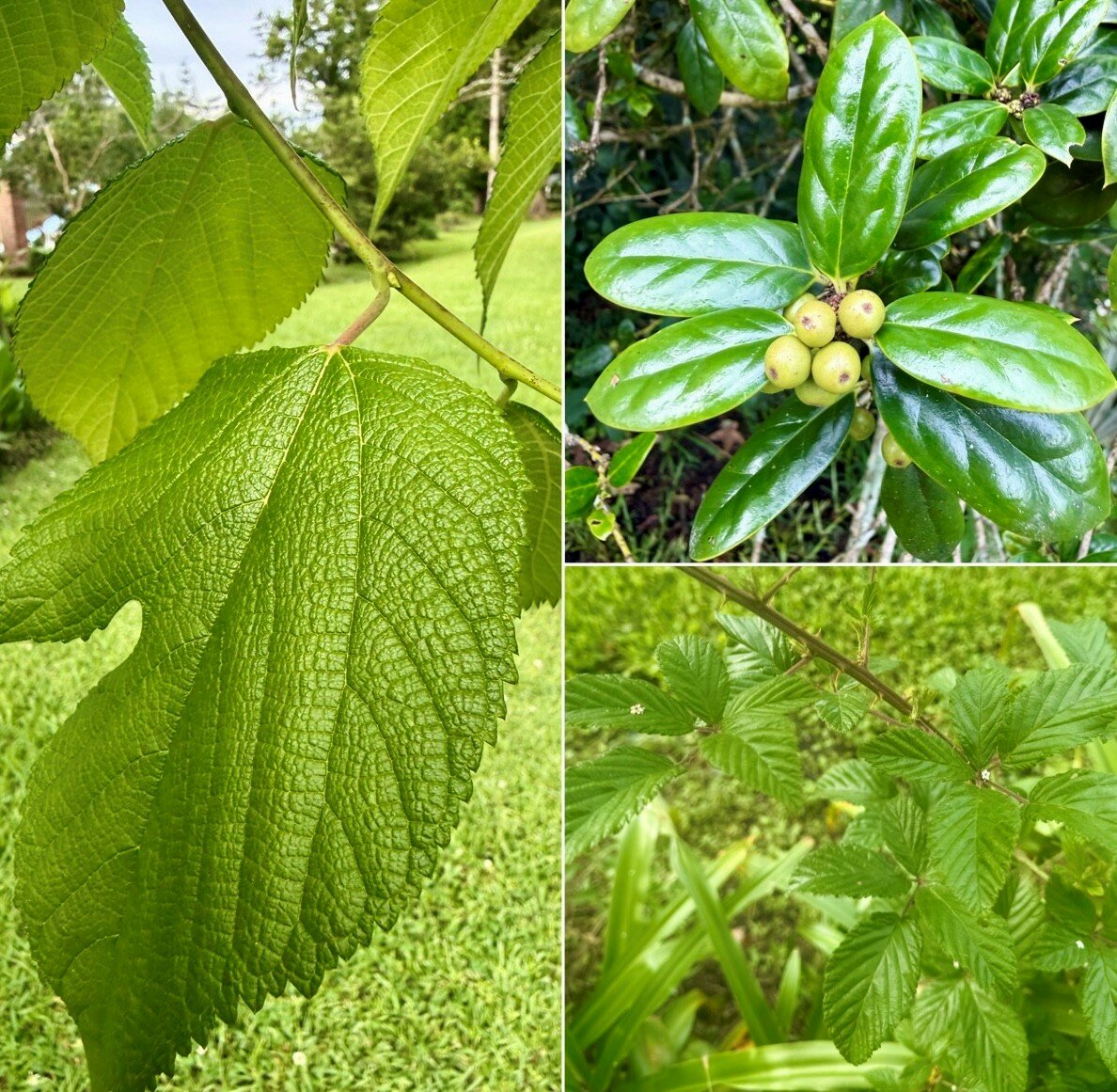
Leaf characteristics remain one of the most useful identification tools, but also one of the most misleading if used alone. The red mulberry, blackberry, and Burford holly pictured illustrate three distinctly different leaf types – mulberry with variable simple leaves, blackberry with palmately compound leaves, and holly with thick, waxy simple leaves. Red mulberry leaves can vary in shape on the same tree – some heart-shaped, others lobed – with serrated margins and fine hairs underneath. They are arranged alternately along the stem. This helps distinguish them from the invasive paper mulberry, which may have opposite or whorled leaf arrangements.
Burford holly also has alternate leaf arrangement but differs in having thick, waxy leaves with smooth (entire) margins. In contrast, yaupon holly – another common species – has smaller leaves with finely scalloped margins, which can cause confusion if only general leaf shape is considered.
Blackberry plants differ from both in that they have compound leaves, typically palmately arranged with multiple leaflets radiating from a central point. This contrasts with simple leaves, which have a single undivided blade. Similar confusion can occur between blackberries and roses, as both have thorny stems and compound leaves, but rose leaves are usually pinnately compound with leaflets arranged along a central rachis.
Another common mix-up occurs between wild onion and wild garlic. Both have narrow, grass-like leaves and a strong odor when crushed. However, wild onion leaves are hollow, while wild garlic leaves are flat – an important distinction for proper identification.
Looking beyond leaves is equally important. Plant habit, bark texture, flowers, and fruit all provide valuable clues. For instance, Carolina cherry-laurel cherry is often confused with invasive camphor tree when young, but differences in leaf smell, fruit, and mature form help distinguish them.
When seeking assistance with plant identification, provide as much information as possible. Include clear, close-up photos of leaves (top and underside), stems, flowers or fruit, and a picture of the entire plant. Also note where the plant is growing - sun or shade, wet or dry soil, and surrounding landscape. These details greatly improve the accuracy of identification.
By focusing on multiple characteristics and using reliable references, you can improve your plant identification skills and avoid common mistakes. A careful, informed approach ensures better management decisions and helps protect our landscapes from invasive species.


