

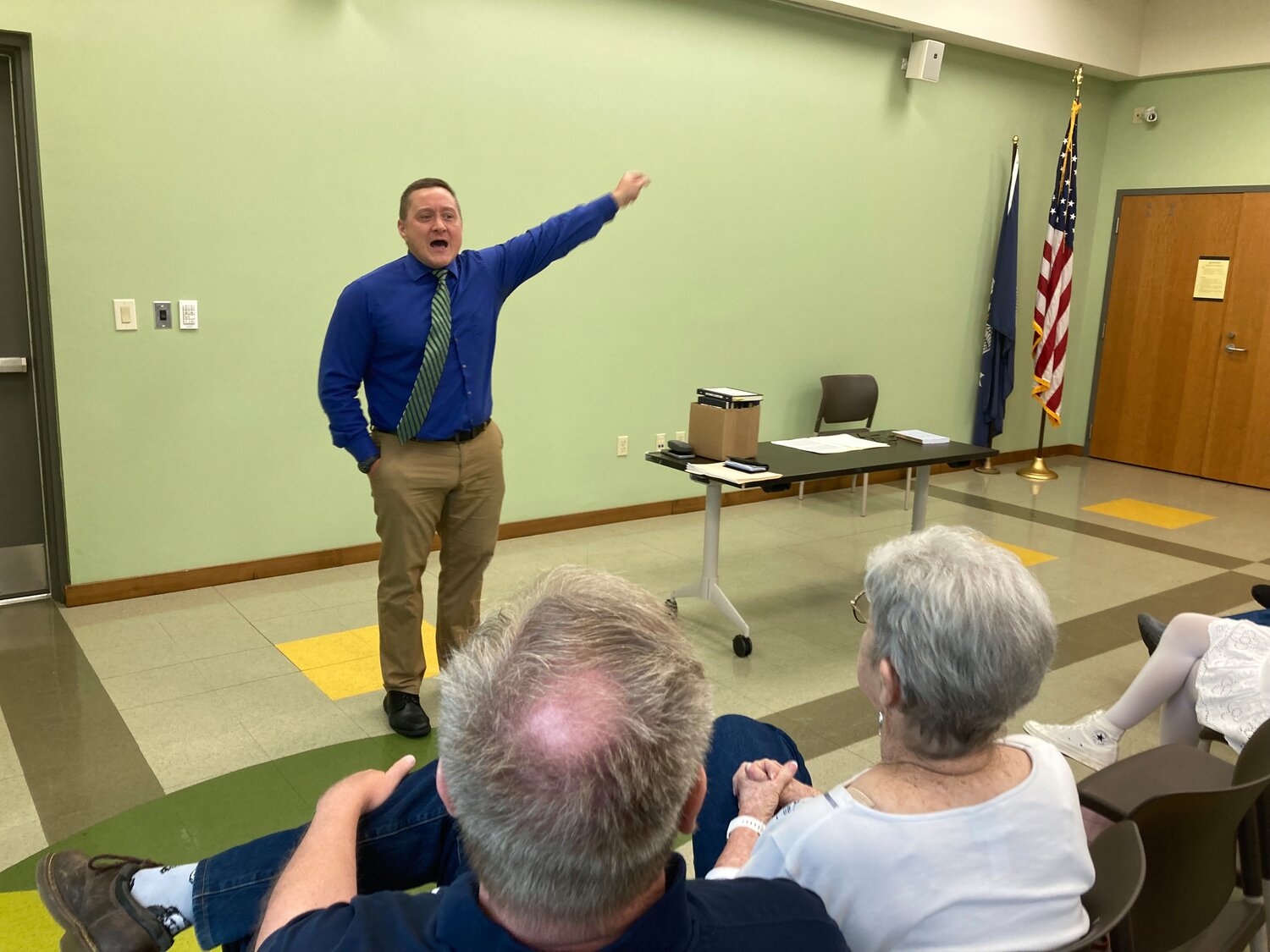
On August 2, members of the Edward Livingston Historical Association gathered at the Livingston Parish Library for a thought-provoking presentation by Dr. Keith M. Finley, an associate professor of history at Southeastern Louisiana University. Finley, the author of From Slavery to Segregation: Reckoning with White Supremacy in the American South, explored the troubling continuity in the arguments used by prominent Southerners over the span of more than a century to defend chattel slavery and Jim Crow segregation laws.
In his animated and engaging style, Finley highlighted recurring themes in Southern rhetoric that sought to justify the oppression of Black Americans. His book, published last year by LSU Press, delves into the historical connections between slavery and segregation. Finley also authored Delaying the Dream: Southern Senators and the Fight Against Civil Rights, 1938-1965, further cementing his expertise in this area of American history.
A native of Queens, N.Y., Finley is beginning his 21st year at Southeastern. In addition to his teaching role, he serves as the assistant director of Southeast Louisiana Studies at the university. Finley contrasted his own upbringing with that of another well-known Queens native, pointing out that while his father was a New York City police officer, Finley’s academic journey led him to Southeastern after discovering that the school only charged $10 to apply for its master’s degree program. After earning his master's, he pursued his doctorate in history at LSU.
During his talk, Finley focused on “threads of continuity” in Southern defenses of slavery and segregation. One notable example was the concept of “paternalism”—the notion that slave owners treated their enslaved workers well and that these workers were content in bondage. Finley debunked this myth, emphasizing that a slave owner who claimed to treat enslaved individuals like family would sell them without hesitation at the first sign of economic hardship.
This paternalistic rhetoric persisted in post-Civil War justifications for Jim Crow laws. Finley cited the example of Allen J. Ellender, a Louisiana senator who served from 1937 until his death in 1972. Ellender argued that 90 percent of his Black constituents preferred segregated schools and other public facilities, an assertion used to defend the status quo of racial segregation.
The discussion also touched on the role of the U.S. Constitution in defending slavery and later supporting Jim Crow laws. Proponents of slavery argued that the Constitution’s emphasis on private property rights justified the ownership of enslaved people, and this constitutional defense was adapted after the Civil War to support segregation and voter suppression, such as through the use of poll taxes to limit Black voting rights.
The event was both an educational and sobering reminder of the persistence of white supremacy in the American South, and it sparked important conversations about how history’s long shadow continues to affect contemporary society.
Looking ahead, the Edward Livingston Historical Association will host a tour of the Laser Interferometer Gravitational-Wave Observatory on September 6, offering a chance to explore the cutting-edge science happening right here in Livingston Parish.


